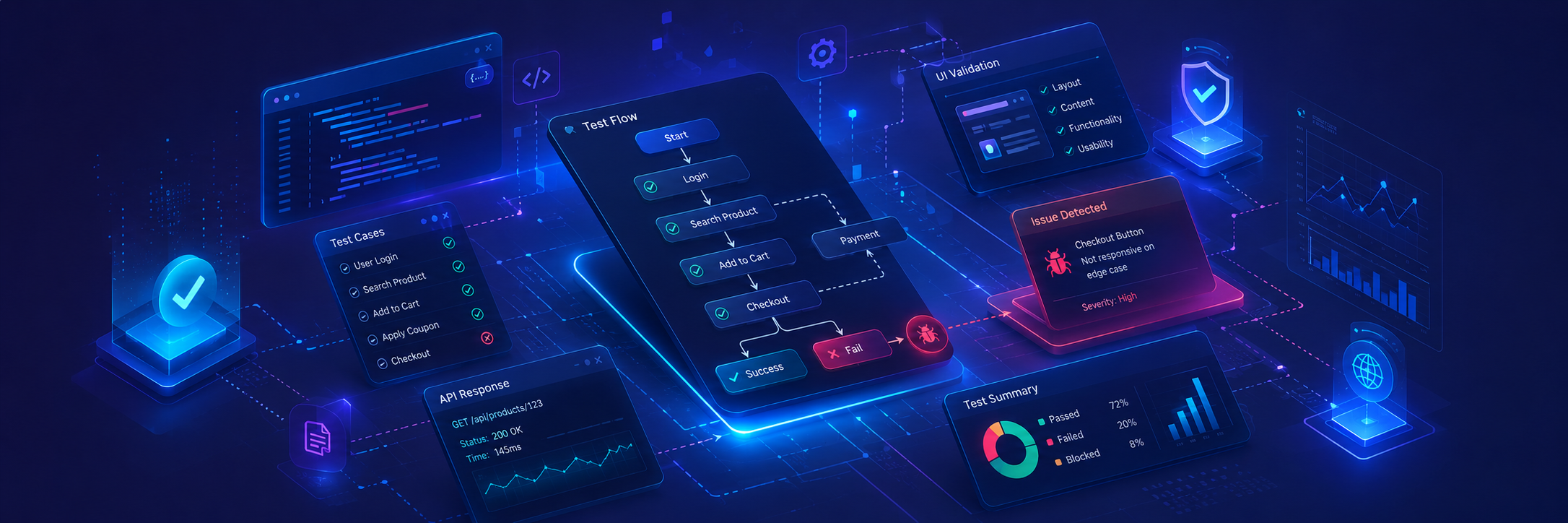

Things You Should Know About Functional Testing
Functional testing checks whether a product actually does what it is supposed to do. It helps teams catch broken flows, failed actions, unclear errors and business logic issues before users find them.
Product quality is one of the clearest ways software teams stand out.
Users may not always notice good testing, but they notice when it is missing. A button does nothing. A payment goes through, but access is not granted. A form accepts the wrong data. A mobile app forgets where the user left off. These are the kinds of issues that quickly turn a good-looking product into a frustrating one.
This is where functional testing becomes important.
Functional testing focuses on one simple but critical question: does the product work the way it is supposed to?
It is one of the most practical forms of software testing because it checks the real behaviour of the product against requirements, business logic and user expectations. For web apps, mobile apps, SaaS platforms, marketplaces and API-driven products, this can make the difference between a confident release and a release full of avoidable issues.
What is functional testing?
Functional testing checks whether a feature performs its intended function.
That may sound simple, but it covers a lot of ground. A QA specialist looks at the product from the user’s side and checks whether each action gives the expected result.
For example, when a user signs up, they should receive a confirmation email. When a customer pays for a course, they should get access to the course. When a user applies search filters, the results should match those filters. When a password field has rules, the product should accept valid passwords and reject invalid ones with a clear message.
Functional testing checks whether these behaviours actually work.
- Do the main features work as intended?
- Can users complete the actions they need?
- Does the product handle wrong input correctly?
- Are error messages clear enough?
- Does the UI match the real system state?
- Does the API return what the product expects?
Functional testing vs non-functional testing
Functional and non-functional testing are both important, but they focus on different things.
Functional testing checks what the product does. Non-functional testing checks how well the product does it.
Take a login feature as an example. Functional testing checks whether a user can log in with correct credentials, whether the wrong password is rejected, whether the correct error message appears, whether password reset works and whether account restrictions are handled correctly.
Non-functional testing checks things like page speed, behaviour under heavy traffic, accessibility, reliability across devices and whether the login process meets broader security expectations.
Both are needed. A login flow can be functionally correct but too slow. It can also be fast but functionally broken. A quality product needs both the feature behaviour and the user experience around it to work well.
Positive and negative test cases
Functional testing is not only about checking the happy path.
A good test does not stop at checking whether a feature works when the user does everything correctly. It also checks what happens when users make mistakes, enter unexpected data or use the product in a less predictable way.
Positive test cases check valid actions. For example, a user enters a valid email, submits all required fields, uses a correct password or completes payment successfully.
Negative test cases check invalid or unexpected actions. For example, a user leaves a required field empty, enters an invalid email format, uses a password that is too short, submits the same request twice, or refreshes during a payment or setup flow.
Negative testing is often where important bugs are found. Real users do not always follow the perfect path. They go back, refresh, mistype, double-click, lose connection, switch tabs or close the app. Functional testing should cover that reality.
Why functional testing matters
Software development takes time, money and effort. Because of that, teams need to make smart decisions about what to test, how deeply to test and when to test.
No QA process can guarantee that every bug will be found. That is not realistic. But functional testing helps reduce the risk of releasing a product that fails in important user flows.
The main value is simple: it helps teams catch issues before users do.
If a checkout flow is broken, the business may lose revenue directly. If a sign-up flow fails, new users may never enter the product. If a dashboard saves changes incorrectly, users may lose trust in the system. If an API accepts the wrong input, the UI may look fine while the backend state becomes incorrect.
Functional testing helps detect these issues while the team can still fix them calmly.
Business benefits of functional testing
Functional testing is not just a technical activity. It has direct business value.
It improves user experience because QA looks at the product from the user’s perspective. The goal is not only to check whether the code runs, but whether the product can be used as expected.
It reduces critical bugs in production by finding broken flows before release. That matters especially for payment flows, account access, booking systems, marketplaces, onboarding and anything connected to business-critical actions.
It gives developers clearer feedback. A useful bug report explains what was tested, what happened, what was expected, how to reproduce it, how serious the issue is and what evidence supports the finding.
It also gives teams better release confidence. A product does not need to be perfect before release, but the team should understand the risks.
Examples of functional bugs
Functional bugs are often easy to understand because they affect normal user actions.
In an e-learning app, a user watches part of a video. They close the app and come back later, but the app does not remember where they stopped. This sounds small, but for the user it is frustrating.
A course or dashboard may work on desktop, but the content does not display properly in the mobile app or mobile browser. The feature may technically exist, but for mobile users it is not usable.
Fitness, finance, booking and productivity apps often depend on calculations. If calories, workout time, balances, prices or totals are wrong, the product loses its purpose very quickly.
One of the more serious examples is payment access. A user pays for gated content, a subscription or a course. The payment is taken, but access is not granted. From the business side, this creates support work and trust issues. From the user side, it feels like the product took money but did not deliver what was promised.
Search and filter bugs are another common example. A user selects filters on a marketplace or search page, but after redirect or refresh the product shows results based on different values. This creates confusion because users cannot trust what they are seeing.
When should functional testing start?
Functional testing should start as early as possible.
Waiting until the end of development makes bugs more expensive and harder to fix. If a core flow has been built on the wrong assumption, finding that late can affect design, frontend, backend, API behaviour and business logic at the same time.
Early testing helps teams catch problems while changes are still easier to make.
This does not mean every feature needs a full QA cycle from day one. The testing effort should match the stage of the product. Early in development, a QA review may focus on main flows and obvious risks. Before release, testing can become more structured with regression checks, edge cases and retesting.
If a checkout flow has issues, the business impact is direct. If a sign-up flow fails, users cannot enter the product. If a booking flow saves the wrong data, operations may be affected. If an API returns the wrong state, the UI may mislead users. These are not issues teams want to discover after launch.
To sum up
Functional testing checks whether a product works as intended.
It verifies that users can complete important actions, that features follow requirements, that errors are handled clearly and that the product behaves correctly across real user flows.
It does not make software perfect. No testing can do that. But it reduces risk, improves release confidence and gives teams clearer information about product quality.
For software teams, functional testing is one of the most practical ways to protect the user experience before release.
Because if the core functions do not work, everything else becomes secondary.
Need practical QA support?
Laidoner Solutions helps software teams with manual QA, API testing, localization review, release checks and clear defect reporting.
Contact Us