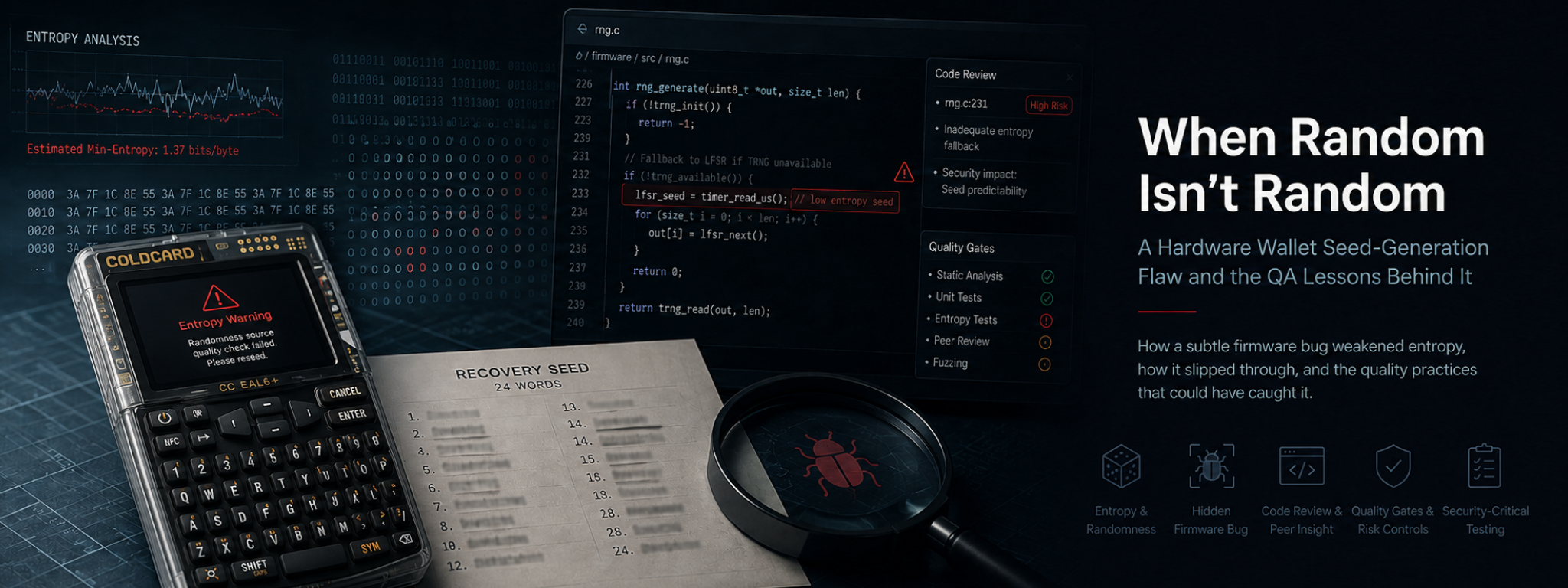

The Coldcard Seed Bug: A QA Lesson in Entropy, Open Source and Missing Quality Gates
A practical QA look at the Coldcard seed generation incident, weak entropy, open-source assumptions and why critical product risks need stronger quality gates.
Hardware wallets are supposed to make one promise very boring: your private key should be generated from enough randomness that nobody can guess it.
That is the foundation. The screen can look nice. The device can feel secure. The firmware can be signed. The brand can have trust. But if the seed phrase is generated from weak or predictable entropy, everything built on top of it becomes fragile.
That is why the Coldcard seed generation incident is interesting from a QA perspective.
It is not only a Bitcoin story. It is not only a firmware story. It is a product-quality story about a critical assumption that appears to have stayed insufficiently guarded for years.
And when a critical assumption survives that long, the uncomfortable question is not only “How did this bug happen?”
The better QA question is: where was the quality gate?
What happened?
Public reporting described a Coldcard issue affecting seed generation, with concerns around weak or predictable randomness in certain firmware and hardware combinations.
CoinEdition reported that Block identified two Coldcard vulnerabilities affecting cryptographic seed generation, and that the issue could affect Mk2, Mk3, Mk4, Mk5 and Q models in different ways.
The important detail for QA is not only the model list. It is the class of failure.
The issue was connected to the process that generates the wallet seed. That is not a small UI defect. It is the root of the wallet.
A seed phrase is the thing that can recreate the wallet. If the seed is weak, the wallet is weak. Updating the device later may fix future generation, but it does not automatically make an already-created weak seed strong.
That distinction matters because users often think in terms of devices and firmware versions. But the real asset at risk is the seed material that already exists.
Why entropy matters
Entropy is a technical word for unpredictability.
For a Bitcoin wallet, unpredictability is everything. A seed phrase should come from a search space so large that nobody can realistically guess it.
If that search space becomes smaller, the attacker no longer needs to search all possible wallets. They only need to search the smaller group of wallets that could be produced by the flawed generation process.
Expected model:
Hardware randomness
→ high-entropy random material
→ BIP-39 seed phrase
→ wallet keys
→ wallet addresses
→ funds protected by an unpredictable seed
Broken model:
Weak or predictable randomness
→ smaller seed search space
→ predictable wallet keys
→ funds become easier to target
That is why entropy bugs are different from normal product defects. A layout bug may annoy users. A validation bug may block a flow. But a seed generation bug can silently weaken the one thing the product exists to protect.
The QA lesson: do not only test the visible flow
From the user’s perspective, seed generation may look successful.
The device shows words. The user writes them down. The wallet opens. Addresses appear. Transactions can be signed. Everything seems fine.
But the most important quality question is hidden below the visible flow: were those words generated from enough unpredictable entropy?
This is the kind of risk ordinary UI testing will not catch.
A normal happy-path test might say:
Generate seed phrase.
Confirm seed phrase.
Open wallet.
Create receiving address.
Result: Pass.
But that does not prove the seed generation process is safe. It only proves the flow completed.
For critical systems, QA needs to ask a different question: what assumption would be catastrophic if it was wrong?
The missing quality gate
Every product has assumptions. Most are harmless. Some are not.
In a hardware wallet, “seed generation produces enough entropy” is not a small implementation detail. It is a critical product assumption.
That means it deserves a quality gate.
A quality gate does not have to mean one specific test. It can be a combination of review, automated checks, runtime safeguards, negative tests, external audit, reproducible builds, threat modelling and release blocking rules.
For a seed generation flow, useful quality gates could include checking whether the hardware random source is actually used, making fallback paths fail closed, testing that firmware changes cannot silently downgrade entropy, reviewing how reseeding works, and adding release checks around critical cryptographic paths.
The important part is that the gate should exist before release, not only after public failure.
Open source is not a replacement for QA
Open source helps. It allows external review, independent analysis and public accountability. That matters.
But open source is not the same as tested quality.
Code being visible does not mean the right people reviewed the right part at the right time. It does not mean the dangerous edge case was covered. It does not mean a release process had a specific gate for the most critical behaviour.
This is one of the uncomfortable lessons from security-related product work. Transparency improves the chance that issues are found, but it does not remove the need for internal quality discipline.
For teams building sensitive products, the correct question is not only “is the code open?”
It is also: what behaviours are protected by tests, reviews and release gates?
A fallback path should not silently weaken security
One recurring pattern in security bugs is the dangerous fallback.
A fallback can be useful in normal software. If one image format fails, try another. If one network request fails, retry. If one UI state is unavailable, show a placeholder.
But in security-critical logic, fallback behaviour needs much more caution.
A weak fallback can turn a safe-looking flow into a broken one:
Expected:
Hardware RNG unavailable → seed generation blocked

Risky:
Hardware RNG unavailable → software fallback continues silently
From a QA perspective, this is a classic negative-path problem.
The test should not only confirm that seed generation works when everything is healthy. It should also confirm what happens when the trusted entropy source is unavailable, broken, misconfigured or returns unexpected data.
In critical systems, failing loudly is often safer than continuing quietly.
Randomness is hard to verify from the outside
One reason entropy bugs are difficult is that weak randomness can be invisible to users.
A seed phrase generated from weak randomness still looks like a normal seed phrase. The words look random. The wallet opens. The addresses look valid.
That is why visual confirmation is not enough.
Research on firmware randomness has shown that hardware RNG behaviour can be difficult for users to distinguish without deeper analysis, and that insecure pseudo-random fallback paths can exist inside real devices.
This makes the QA problem more serious. If the output looks normal even when the underlying process is weak, the product needs stronger internal checks.
A user should not be expected to detect weak entropy by looking at twelve or twenty-four words.
The risk of testing only the happy path
A happy-path seed generation test is easy to imagine.
The device generates words. The confirmation screen works. The recovery check passes. The wallet opens. The UI behaves as expected.
That is useful, but it is not enough.
The risky cases are different:
What if the entropy source fails?
What if reseeding keeps too little entropy?
What if a fallback path is used?
What if old firmware generated weak seeds?
What if the UI says the wallet is safe when the seed is not?
These are not ordinary acceptance tests. They are product-risk tests.
For critical systems, QA needs to help identify these risk areas even if developers, security engineers or external auditors perform the deepest technical validation.
The user communication problem
Incidents like this also expose another quality area: user communication.
When the root issue affects old seeds, the guidance must be extremely clear. Users need to understand whether they should update firmware, generate a new seed, move funds, add a passphrase, avoid reusing the old seed, or take some other action.
This is not only a support issue. It is product quality.
Bad communication can turn a technical vulnerability into a larger user-impact problem. If users think a firmware update alone fixes an old weak seed, they may still be exposed.
For QA, this means release notes, warnings, migration flows and recovery instructions should be tested as part of the product experience.
What a stronger QA mindset would ask
A stronger QA approach does not mean QA engineers personally prove cryptographic randomness.
It means the team treats the risk as important enough to require evidence.
Some useful questions would be:
Which part of the system creates entropy?
What happens if that source fails?
Can a fallback path silently reduce security?
Is seed generation covered by release-blocking tests?
Are firmware changes reviewed against this risk?
Can old weak seeds be detected or warned about?
Is user guidance clear after a fix?
These questions do not replace cryptographic review. But they help make the invisible risk visible in the product process.
This is not only about hardware wallets
The lesson applies far beyond Bitcoin wallets.
Many products depend on hidden assumptions. A payment product assumes balances are calculated correctly. A lending product assumes liquidation rules are correct. A healthcare product assumes access control works. A localization system assumes users see the right market-specific content. An API product assumes backend validation is stricter than frontend validation.
When those assumptions are wrong, the product may still look fine during normal testing.
That is why quality work cannot only ask whether the flow works. It also has to ask what must never silently fail.
The bigger the impact of a hidden assumption, the stronger the quality gate should be.
Where Laidoner Solutions helps
Laidoner Solutions helps software teams look at quality beyond the visible happy path.
That can include manual QA, exploratory testing, API validation, regression checks, localization QA, automation support and product quality reviews.
The goal is not to replace developers, security specialists or auditors. The goal is to help teams notice risky assumptions earlier, collect better evidence and report issues in a way that reduces guesswork.
For teams building serious products, this kind of practical quality work matters because the most expensive defects are often not the obvious ones.
They are the assumptions nobody checked deeply enough.
Final thoughts
The Coldcard seed bug is a strong reminder that product quality is not only about screens, buttons and user flows.
Sometimes the most important part of a product is invisible.
If that invisible part fails, the visible product can still appear to work while the real protection is already gone.
That is the QA lesson here.
Critical assumptions need critical quality gates. Open source helps, but it does not replace testing. A successful UI flow is useful, but it does not prove the system is safe.
Good QA does not only ask whether the product works.
It asks what would happen if the most important assumption was wrong.
Sources and further reading
- CoinEdition — Coldcard Wallet Vulnerabilities Explained
- CoinEdition — 594 BTC Stolen From 500 Wallets as Coldcard Seed Flaw Investigated
- New York Post — Crypto hackers drain millions from Coldcard-linked software flaw
- News.com.au — Major bitcoin flaw sees wallets drained
- Block Engineering — Predictable RNG Fallback and 32-Bit Reseed in COLDCARD Firmware
- Firmware Insider: Bluetooth Randomness is Mostly Random
Need practical QA support?
Laidoner Solutions helps software teams with manual QA, API testing, localization review, release checks and clear defect reporting.
Contact Us